Stop Overcomplicating Your Food Storage Plan
Most preppers spend too much time debating freeze-dried brand labels and not enough time building a storage system that actually works under pressure. After years of covering survival gear and talking to people who’ve lived through real disruptions — ice storms, job loss, supply chain failures — the pattern is clear: the basics done right beat the fancy solutions every time.
This guide cuts straight to what matters in long-term food storage, what you can safely deprioritize, and how to build a system that feeds real people through real emergencies.
The Foundation: Calories First, Variety Second
Your first job in food storage is not to replicate your current grocery cart. It’s to guarantee enough calories to keep people functional. Everything else is secondary.
Start with these calorie-dense, shelf-stable staples:
- White rice — 25-year shelf life when sealed properly, roughly 1,600 calories per pound
- Hard red or white wheat — requires a grinder but offers nutrition and versatility
- Dried beans and lentils — protein, fiber, and long shelf life when stored in airtight containers
- Rolled oats — fast to prepare, high caloric value, 5–8 year shelf life in sealed buckets
- Pasta — underrated, cheap, and stores well for 10+ years in sealed containers
These five alone can sustain a household through months of disruption. Build a deep reserve of these before spending a dollar on specialty items.
What the Marketing Machine Wants You to Buy First
Walk into any prepper retailer and you’ll see expensive freeze-dried meal kits front and center. They’re not bad products — but they’re often the wrong starting point.
Here’s the problem: a 72-hour emergency food kit for one person might run $80–$150. That same money, spent on bulk rice, beans, and oats, could feed one person for 60 to 90 days if rationed. The math isn’t subtle.
Freeze-dried and dehydrated specialty foods have their place — primarily for grab-and-go bug-out bags, or to add meal variety after your foundation is already solid. Don’t let attractive packaging pull your budget away from core supplies.
The Rotation Principle: Use It or Lose It
A food storage system that doesn’t rotate is a slowly degrading investment. Even the best-sealed buckets of rice aren’t immortal, and neglected stores develop off flavors, pest infiltration, or moisture damage over time.
First In, First Out (FIFO)
Label every container with the purchase or pack date. When you add new stock, move older supplies to the front. Pull from the front. This keeps your entire inventory cycling through real use rather than sitting untouched until a crisis reveals the damage.
Build Around What You Already Eat
The most sustainable storage system is one built around your household’s actual diet. If your family eats pasta twice a week, storing 100 pounds of pasta makes sense — you’ll rotate through it naturally. If you’ve never cooked with dried lentils, storing 50 pounds of them is a gamble. They may sit unused until the day you desperately need to cook something you’ve never prepared before.
Practical rule: store what you eat, eat what you store.
Water: The Variable People Chronically Underestimate
Food storage without water planning is half a strategy. Many dry staples — rice, beans, pasta, oats — require significant water to prepare. In an emergency where water supply is compromised, your food supply may become inaccessible without a parallel water solution.
- Store a minimum of one gallon per person per day, targeting a two-week supply as your baseline
- Add a quality water filter (Sawyer, Berkey, or equivalent) to your system
- Identify a secondary water source near your location — well, stream, or rain collection point
- Stock water purification tablets as a lightweight backup option
Don’t let a sophisticated food supply get stranded by a failure to plan for water.
Containers and Storage Conditions: Where Most People Cut Corners
The shelf-life numbers you see on packaging assume ideal storage conditions. Most people’s storage conditions are not ideal.
The Four Enemies of Long-Term Storage
- Heat — every 10°F rise in storage temperature roughly halves shelf life
- Moisture — drives mold, bacterial growth, and clumping
- Light — degrades fats and vitamins over time
- Oxygen — the primary driver of rancidity and nutrient loss
A cool, dark, dry environment is the baseline requirement. An interior room or basement consistently below 70°F is significantly better than a garage that swings between 40°F and 100°F across seasons.
Container Choices That Hold Up
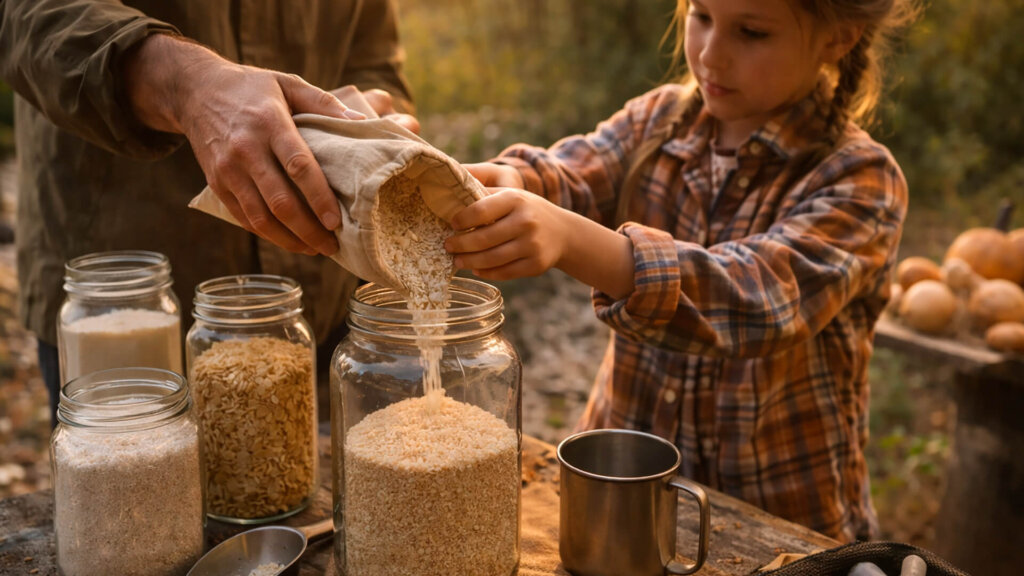
Food-grade 5-gallon buckets with gamma-seal lids are the workhorse of serious food storage. Pair them with mylar bags and oxygen absorbers for bulk grains and legumes, and you can legitimately hit those 20–25 year shelf life targets under good conditions. Glass mason jars work well for smaller quantities and offer the advantage of being completely airtight and pest-proof.
Avoid: flimsy zip-lock bags, original paper or cardboard packaging, and any container that isn’t truly airtight for anything you’re storing beyond 6 months.
Nutrition Gaps You Need to Address
A diet of rice, beans, and oats keeps you alive. It won’t keep you fully healthy over the long term without intentional additions.
Common deficiencies in basic carbohydrate-heavy emergency diets include:
- Vitamin C — store multivitamins and consider freeze-dried or canned fruits
- Fats — coconut oil, olive oil, and ghee store reasonably well and are calorically critical
- Vitamin D and B12 — especially relevant if your grid-down scenario eliminates sunlight exposure or animal products
- Iodine — use iodized salt and consider storing it specifically for this reason
A good-quality multivitamin supply is cheap insurance against nutritional gaps during extended disruptions. Don’t skip it.
Teaching Practical Skills Alongside Storage
Stored food is only useful if someone in your household knows how to prepare it — especially from scratch, without modern conveniences. This is where food storage intersects directly with skill-building.
If your plan includes 100 pounds of hard wheat berries, does anyone in your home know how to use a manual grain mill and bake a functional loaf of bread? If the answer is no, that wheat is dead weight during a crisis.
Start cooking from your storage regularly. Make bean soup from dried beans. Bake bread from stored flour. Cook oatmeal from rolled oats. These aren’t dramatic survival skills — they’re basic cooking knowledge that got lost in the convenience food era. Reclaiming them now, in low-stakes conditions, means they’ll be available when the stakes are high.
Building Your Storage in Stages
You don’t need to build a year’s supply overnight. A staged approach keeps the project manageable and prevents the financial strain that causes people to abandon the effort entirely.
- Stage 1 (Month 1–2): Two-week supply for your household — water, rice, beans, oats, canned goods
- Stage 2 (Month 3–6): Expand to 90 days, add fats, salt, sugar, and basic spices
- Stage 3 (Month 6–12): Push toward six months to one year, add freeze-dried proteins and variety items
- Ongoing: Maintain rotation, audit annually, and adjust for household changes
Each stage represents real, functional resilience. Even stopping at Stage 1 puts you ahead of the overwhelming majority of households.
The Bottom Line
Long-term food storage isn’t complicated, but it does require making smart choices about where your time and money go. Prioritize caloric foundation before specialty products. Store what your household actually eats. Control your storage environment. Plan for water. Close the nutritional gaps. And make sure someone in your home knows how to cook what you’ve stored.
Build the boring foundation first. The interesting additions come later — and they’ll actually be useful because the fundamentals are already solid.